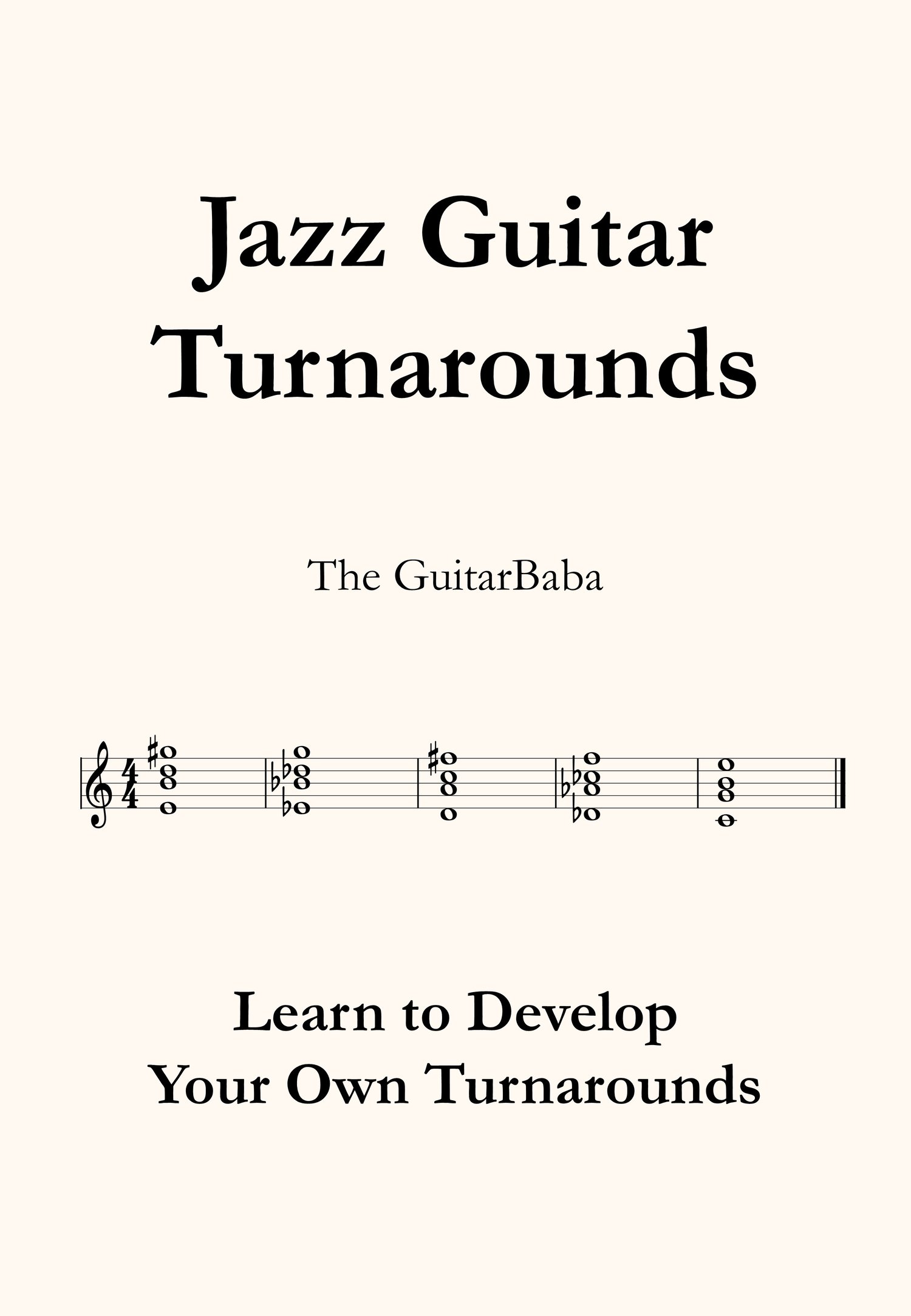
Understanding Jazz Guitar Turnarounds
A turnaround is more than a fixed four-chord pattern. The familiar I–vi–ii–V progression can be approached in many ways, and relatively small changes to individual chords can produce very different harmonic movement.
This makes the turnaround a useful framework for studying jazz harmony.
Rather than treating substitutions as isolated chord tricks, Jazz Guitar Turnarounds looks at how they function within the progression as a whole, including how additional harmonic movement can be introduced while still working within the four-bar structure.
The concepts explored include mediant substitution, secondary dominants, chains of secondary dominants, ii–V expansion, tritone substitution and diminished passing chords.
For Guitarists Interested in Harmony
Many guitarists become familiar with the I–vi–ii–V turnaround but find it difficult to understand what to do with it beyond playing the same progression in different keys.
The book gives them a way to explore the harmonic choices within the turnaround. Instead of learning substitutions as unrelated ideas, they can see how each one changes the progression and how different harmonic approaches can still lead to the same destination.
This makes it easier to recognise these sounds when they appear in jazz standards and to begin using similar ideas in their own playing.
The Central Idea
The starting point is a simple progression:
I – vi – ii – V
→ I
The interesting part is what can happen between those harmonic destinations.
A chord can be approached through a secondary dominant. A dominant can be replaced through tritone substitution. A diminished chord can create chromatic movement between two destinations. The tonic itself can be approached through a related mediant chord.
These ideas show how a familiar turnaround can become a framework for developing new harmonic possibilities.
Included in the Book
It includes:
· standard notation
· guitar TAB
· chord diagrams
· guitar voicings
· written exercises
· audio examples